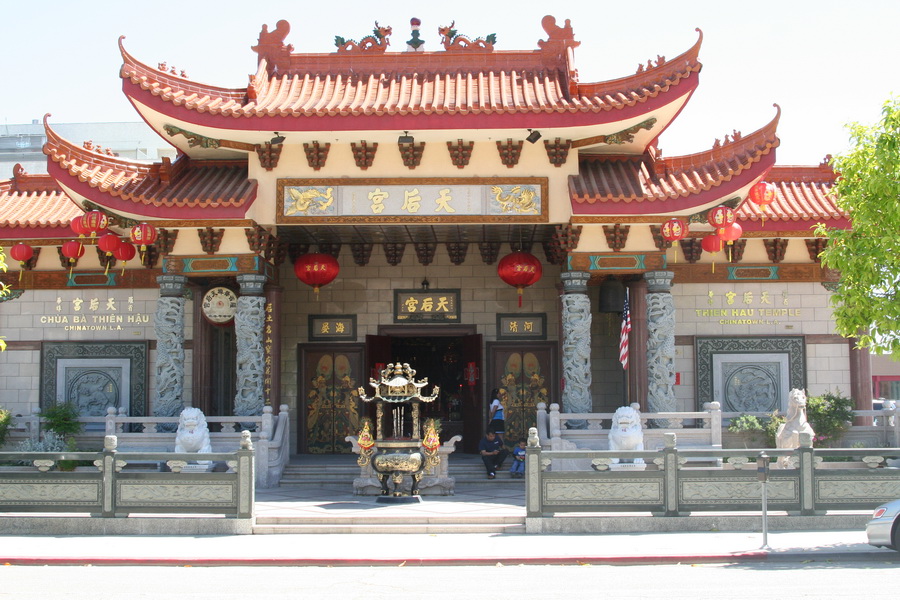

Mazu
Mazu, also spelled Matsu, Tin Hou in Cantonese, Thien Hau in Vietnamese; is the indigenous goddess of the sea who protects fisherman and sailors, and is invoked as the goddess who protects East Asians who are associated with the ocean. Her mortal name is Lin Moniang. She is widely worshiped in the south-eastern coastal areas of China and neighboring areas, especially Zhejiang, Fujian, Taiwan, Guangdong, and Vietnam, all of which have strong sea-faring traditions, as well as migrant communities elsewhere with sizable populations from these areas.
According to the legend, Lin Moniang was born in 960 as the seventh daughter of Lin Yuan on Meizhou Island, Fujian. She did not cry when she was born, and hence her given name means “Silent Girl”. According to legend, Lin Moniang’s father and brothers were fisherman. She wore red garments while standing on the shore to guide fishing boats home, even in the most dangerous and harsh weather. After her death, the families of many fisherman and sailors began to pray in her honor of her acts of courage in trying to save those at sea.
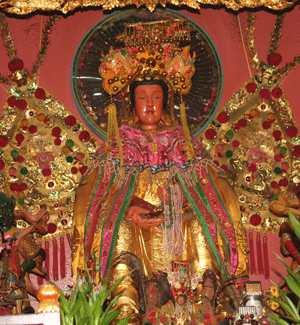
Mazu is usually depicted wearing a red robe in paintings or murals, but in sculpture is clothed in the robes of an empress holding a ceremonial tablet and wearing the easily recognized flat-topped imperial cap with hanging beads front and back. Mazu is usually depicted together with two guardian Generals.
Guan Yu
Guan Yu is one of the best known Chinese historical figures throughout East Asia. Guan Yu was a general under the warlord Liu Bei during the late Eastern Han Dynasty and Three Kingdoms era of China. He played a significant role in the civil war that led to the collapse of the Han Dynasty and the establishment of the Kingdom of Shu, of which Liu Bei was the first emperor.
Guan Yu was deified as early as the Sui Dynasty and is still being worshiped today among the Chinese people variedly as an indigenous Chinese deity, a Bodhisattva in Buddhism, and a guardian deity in Taoism. Guan Yu is sometimes called the Taoist god of war as he is one of the most well-known military generals in Chinese History. In general worship, Guan Yu is widely referred to as Emperor Guan. He is respected as the epitome of loyalty and righteousness.
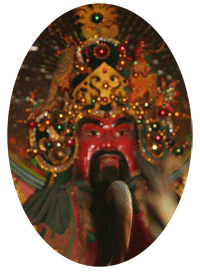
Guan Yu is traditionally portrayed as a red-faced warrior with a long lush beard, often carrying his weapon called Green Dragon Crescent Blade. The idea of his red face could have been borrowed from opera representation, where red faces depict loyalty and righteousness.
Fu De
Fu De, also known as Tu Di Gong, is a local earth god worshiped in China. A popular Chinese deity, he is worshiped by Chinese folk religion worshipers and Taoists. A formal name for Tu Di Gong is Fúdézhèngshén (福德正神), meaning the earth god of wealth and merit. Commoners often called Tu Di Gong “Grandpa”.
In China, every village had a shrine to Tu Di Gong, the deity who was in charge of administering the affairs of a particular village. In traditional times, village concerns were primarily agricultural or weather-related. This god was not all-powerful, but was a modest heavenly bureaucrat to whom individual villagers could turn to in times of drought or famine.
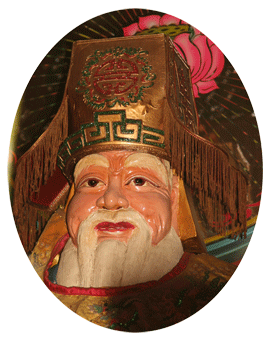
Today, he is still worshiped by most Chinese, with many housing small shrines with his image, commonly located under the main altar or below the house door. Worshipers make prayers to him for wealth and their well being. Tu Di Gong is portrayed as an elderly man with a long white beard, a black or gold hat and a red or yellow robe, which signifies his position as a bureaucrat.